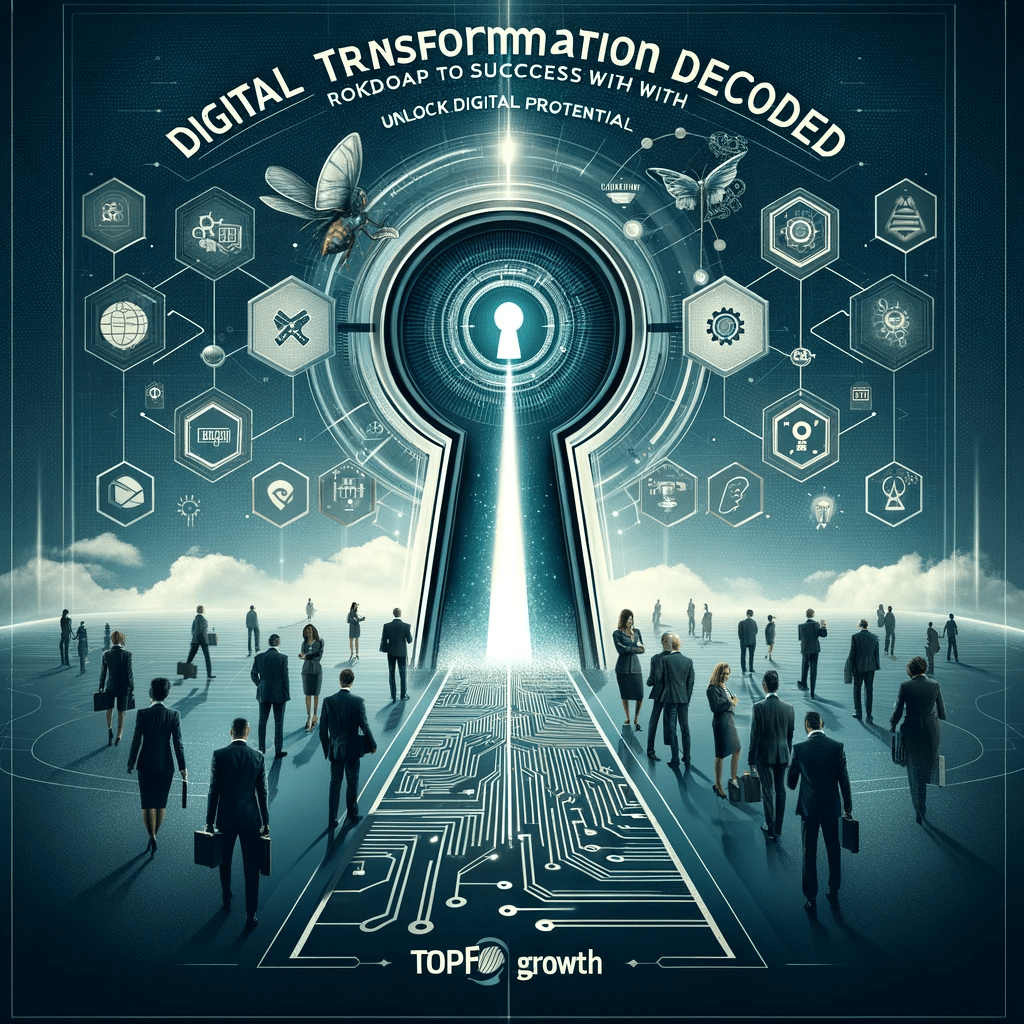
Introduction:
The digital era is reshaping the business landscape, making digital transformation a strategic imperative for companies seeking to sustain and enhance their competitive edge.
This transformation is more than a mere technology upgrade; it’s a rethinking of business models and processes to capitalize on digital advancements.
This blog aims to demystify digital transformation, offering practical insights into how it can be strategically implemented to drive your company forward.
We’ll examine its core components, strategic execution, real-life corporate successes, and how to measure its impact effectively.
As Senior Consultant, in TOPForGrowth, our goal is to equip the Senior Managers, with the knowledge to navigate this transformative journey successfully.
Join us as we explore actionable steps and strategies to harness the full potential of digital transformation for your business.
Section 1: Decoding Digital Transformation
Digital transformation involves integrating digital technology into all aspects of a business, fundamentally changing how you operate and deliver value to customers.
It’s also a cultural change that requires organizations to continually challenge the status quo, experiment, and get comfortable with failure. Here’s what senior managers need to know:
The Essence of Digital Transformation
It’s not just about technology: While digital tools are part of the transformation, the essence lies in the ability to use these tools to improve business performance.
Transformation is holistic: It affects every area of the business, from strategy and marketing to operations and HR.
It’s ongoing: Transformation is not a one-time project but an evolving journey as technology and customer expectations continue to change.
Key Drivers of Digital Transformation
Customer expectations: Today’s customers expect seamless, personalized experiences across all channels.
Data-driven decisions: Leveraging big data and analytics can lead to better strategic decisions.
Innovation pressure: Competitors and startups are disrupting markets, making innovation a necessity.
Operational efficiency: Digital solutions can streamline operations and reduce costs.
Strategic Implications for Senior Management
Vision and commitment: Leaders must set a clear digital vision and commit to the long-term journey.
Resource allocation: Investments in digital capabilities, including people and technologies, are essential.
Change management: A methodical approach to managing change, with a focus on people, processes, and technology.
Risk management: Understanding and mitigating the risks associated with digital initiatives.
In the following sections, we will explore the pillars of this strategy and how to implement it effectively in your organization.
As a senior manager, it’s vital to grasp these concepts to steer your company through the digital landscape confidently.
Section 2: The Five Pillars of Digital Transformation
For a successful digital transformation, it is crucial to focus on five primary areas that form the pillars of this strategic initiative. These pillars serve as the foundation upon which a company can build a robust and future-proof digital strategy.
Customer Engagement: The digital age has empowered customers with more choices and elevated their expectations. Companies need to leverage digital channels to engage with customers effectively, offering personalized experiences and responsive service. This means utilizing customer data to understand behavior and preferences, and then delivering solutions tailored to individual needs.
Operational Agility: Being agile means more than just speed; it’s about the flexibility to adapt to market changes and new opportunities quickly. Digital transformation can streamline processes, reduce redundancies, and enable faster decision-making. Automation and AI are often key components in achieving operational agility.
Workforce Enablement: Digital tools can empower your workforce to be more productive and efficient. By providing the right technology, training, and support, you can enable your employees to work from anywhere and collaborate effectively. This pillar is also about cultivating a digital mindset throughout the organization.
Digital Technology Integration: This pillar focuses on integrating advanced digital technologies such as cloud computing, big data, IoT, and AI into your business operations. The aim is to not just add technology, but to integrate it in a way that is seamless and drives value.
Corporate Culture and Leadership: Perhaps the most challenging aspect of digital transformation is cultural change. It requires strong leadership to drive the initiative and embed a digital-first mindset across the organization. Leaders must encourage innovation, collaboration, and a willingness to experiment and learn from failures.
Each of these pillars is interconnected, and weakness in one can undermine the entire transformation effort. As we delve deeper into each pillar in the following sections, keep in mind that balance and alignment are key to a holistic digital transformation strategy.
Section 3: Crafting a Digital Transformation Strategy
To harness the full potential of digital transformation, a well-thought-out strategy that aligns with your corporate vision is imperative. Here’s how you can craft a strategy that sets your organization up for a successful digital transformation:
1. Conducting a Digital Readiness Assessment: Before jumping into action, assess your current digital state, including infrastructure, talent, and processes. Identify what’s working well and where the gaps lie. This assessment will serve as a blueprint for your strategy.
2. Setting Clear, Achievable Goals: Define what digital transformation means for your organization. Is it about improving customer experience, enhancing operational efficiency, or driving innovation? Set SMART goals—specific, measurable, achievable, relevant, and time-bound—to guide your efforts.
3. Building a Roadmap with Milestones: Develop a phased approach to transformation with clear milestones. This may involve quick wins in the short term to build momentum and more complex initiatives in the longer term.
4. Securing Leadership and Stakeholder Buy-In: Digital transformation requires commitment from the top down. Ensure that leaders are not only supportive but are active champions of digital initiatives. Similarly, engage stakeholders across the organization to foster a collective effort.
5. Investing in Technology and Talent: Identify the technologies that will drive your digital transformation and invest accordingly. Equally important is investing in your people—upskilling current employees and recruiting new talent with the required digital expertise.
6. Prioritizing Cybersecurity and Compliance: As you become more digital, your risk profile changes. Implement robust cybersecurity measures and ensure compliance with relevant regulations to safeguard your organization.
7. Embracing an Agile Mindset: Be prepared to iterate and adapt your strategy as you go. Digital transformation is not a linear process; it’s agile and responsive to feedback and changes in the environment.
8. Building an Adequate Organization: Success in digital transformation also hinges on structuring an organization that’s agile and equipped to handle continuous change.
9. Measuring Progress and Impact: Track your progress against the goals and milestones you’ve set. Use data and analytics to measure the impact and refine your strategy as needed.
By following these steps, you can create a digital transformation strategy that is comprehensive, actionable, and aligned with your corporate goals. In the next sections, we will explore real-world examples of successful digital transformation and how to tackle common challenges.
Section 4: Success Stories of Digital Transformation
Illustrating the abstract concepts of digital transformation with concrete examples can be highly instructive. Here, we highlight a few companies that have excelled in their digital transformation journey, offering valuable lessons for senior managers.
Embracing E-commerce: A renowned fashion retailer, previously reliant on brick-and-mortar stores, pivoted to e-commerce in response to changing consumer habits. By integrating digital technologies, they created an omnichannel experience that increased their reach and sales. Key takeaways include the importance of meeting customers where they are and the value of a seamless online-offline experience.
Leveraging Cloud Computing: A traditional manufacturing company adopted cloud computing to enhance its operational efficiency. This shift enabled them to scale resources as needed, improve collaboration among global teams, and reduce costs. This case underscores the benefits of flexibility and the scalability of cloud solutions.
Utilizing Data Analytics: A healthcare provider implemented data analytics to improve patient care. By analyzing patient data, they were able to personalize treatment plans and improve outcomes. This example highlights how data can be a powerful tool for not just business efficiency but also for enhancing the quality of service.
Innovating with IoT: An energy company integrated IoT (Internet of Things) devices across its operations to monitor and manage energy consumption in real-time. This led to significant cost savings and a reduction in their carbon footprint. The lesson here is that digital technologies can drive both profitability and sustainability.
Incorporating Artificial Intelligence: A multinational bank embarked on a digital transformation by integrating Artificial Intelligence (AI) into its services. They utilized AI to enhance customer service through chatbots that provided 24/7 support and personalized financial advice. Additionally, AI-driven analytics helped in identifying fraudulent activities in real-time, significantly reducing the incidence of financial fraud. By leveraging AI, the bank not only improved customer satisfaction but also increased operational efficiency and security.
In each of these narratives, the recurring theme is clear: strategic foresight, a willingness to embrace change, and a commitment to digital innovation are crucial for realizing the full benefits of digital transformation.
Section 5: Overcoming Digital Dilemmas
While the benefits of digital transformation are clear, the path to achieving it is often fraught with challenges. Senior managers must navigate these dilemmas carefully to ensure a smooth transition. Let’s explore some common challenges and how to overcome them.
Resistance to Change: One of the most significant hurdles is the natural resistance to change found within any organization. Employees may be comfortable with existing processes and wary of new technologies.
Solution: Involve employees early in the process, communicate the benefits clearly, and provide ample training. Address concerns by demonstrating how digital tools will make their work easier and more rewarding.
Skill Gaps: As technology evolves, there may be a gap between the skills your workforce possesses and those required for new digital tools.
Solution: Invest in training and development programs. Consider hiring new talent with the necessary digital expertise and create a culture that values continuous learning.
Integration Complexities: Integrating new digital technologies with existing systems can be complex and costly.
Solution: Start with a thorough analysis of current systems and processes. Choose technologies that are compatible with your existing infrastructure or be prepared for a gradual phase-out of legacy systems.
Data Security and Privacy: With the increased use of digital technologies, data breaches become a significant risk.
Solution: Prioritize cybersecurity from the start. Implement robust security protocols, educate employees on data privacy, and ensure compliance with all relevant regulations.
Alignment and Collaboration: Ensuring that digital transformation efforts are aligned with overall business goals, and that departments collaborate effectively can be challenging.
Solution: Maintain open lines of communication between departments. Set shared goals and collaborate on cross-functional initiatives that support the digital strategy.
Budget Constraints: Digital transformation can be expensive, and budgets may not always stretch to cover the desired technologies.
Solution: Focus on technologies with the highest return on investment. Consider phased implementations to spread out costs, and look for innovative funding methods or partnerships.
Cultural Shift: Adopting a digital-first mindset is perhaps the most challenging aspect of transformation.
Solution: Lead by example. Encourage risk-taking and innovation from the top down, and recognize and reward digital initiatives.
By proactively addressing these challenges, you can pave the way for a successful digital transformation. In our next section, we will discuss how to measure the success of your digital transformation initiatives to ensure they deliver the intended value.
Section 6: Measuring the Impact
Measuring the success of digital transformation is crucial to understand its impact and to make informed decisions moving forward. Here’s how senior managers can approach this task:
Defining Key Performance Indicators (KPIs): Begin by establishing KPIs that align with your digital transformation goals. These could range from customer satisfaction scores and employee engagement levels to more quantifiable metrics like operational efficiency and revenue growth.
Continuous Monitoring: Set up systems to continuously monitor these KPIs. Utilize dashboards that provide real-time data, allowing for timely adjustments to your strategy.
Feedback Loops: Incorporate feedback mechanisms to capture the experiences of both customers and employees with new digital tools and processes. This qualitative data is invaluable for iterative improvements.
Benchmarking: Compare your progress with industry benchmarks or past performance to evaluate the relative success of your digital initiatives.
ROI Analysis: Calculate the return on investment for your digital projects. This includes direct financial gains as well as intangible benefits like brand enhancement and market positioning.
Scalability and Sustainability: Assess how well the new digital solutions are scaling and their sustainability over time. This will help in planning for future expansion or adjustments.
Adaptation and Learning: Finally, consider how your organization has adapted to the digital changes and the learning that has occurred. This can be a measure of the long-term cultural shift and capability building.
By focusing on these areas, you can develop a comprehensive understanding of the impact of your digital transformation efforts. Remember, the ultimate goal of measuring success is to learn, adapt, and continually improve your digital strategy.
In the conclusion that follows, we’ll wrap up our discussion on digital transformation and leave you with some parting thoughts on the journey ahead.
Conclusion:
The path to digital transformation is continuous and ever-evolving, embodying a series of strategic decisions that can redefine your business’s trajectory. Throughout this journey, the importance of leadership, vision, and a collaborative approach to change cannot be overstated. The pillars of customer engagement, operational agility, workforce enablement, technology integration, and digital culture are not just concepts but actionable areas where TOPForGrowth can provide significant support and guidance.
For senior managers, the journey of digital transformation is both exhilarating and daunting. The responsibility to drive change, foster innovation, and ensure a seamless transition is immense. Yet, it is a path paved with opportunities for growth and leadership in an increasingly digital marketplace. The challenges, while substantial, can be met with the right approach—strategic planning, skillful execution, and an adaptable mindset.
As you consider the strategies for digital transformation outlined in this blog, remember that TOPForGrowth stands ready to assist. Our association of professionals brings a wealth of expertise, particularly in crafting a Digital Transformation Strategy as detailed in Section 3. We understand the nuances of change management, the intricacies of technology integration, and the critical need for a digital-forward culture.
In partnering with TOPForGrowth, you gain access to a network of seasoned experts committed to ensuring that your digital transformation strategy is not just a concept, but a reality that propels your business forward. Whether it’s through personalized consultancy, strategic workshops, or hands-on support, our goal is to help you navigate the digital landscape successfully.
As we conclude, let’s view digital transformation not just as a series of tasks to be completed, but as a strategic endeavor that can unlock your company’s potential. The digital future is rich with possibilities, and with TOPForGrowth by your side, you are well-equipped to lead your organization towards enduring success.
 TOPFramework.Org
Lascia un commento