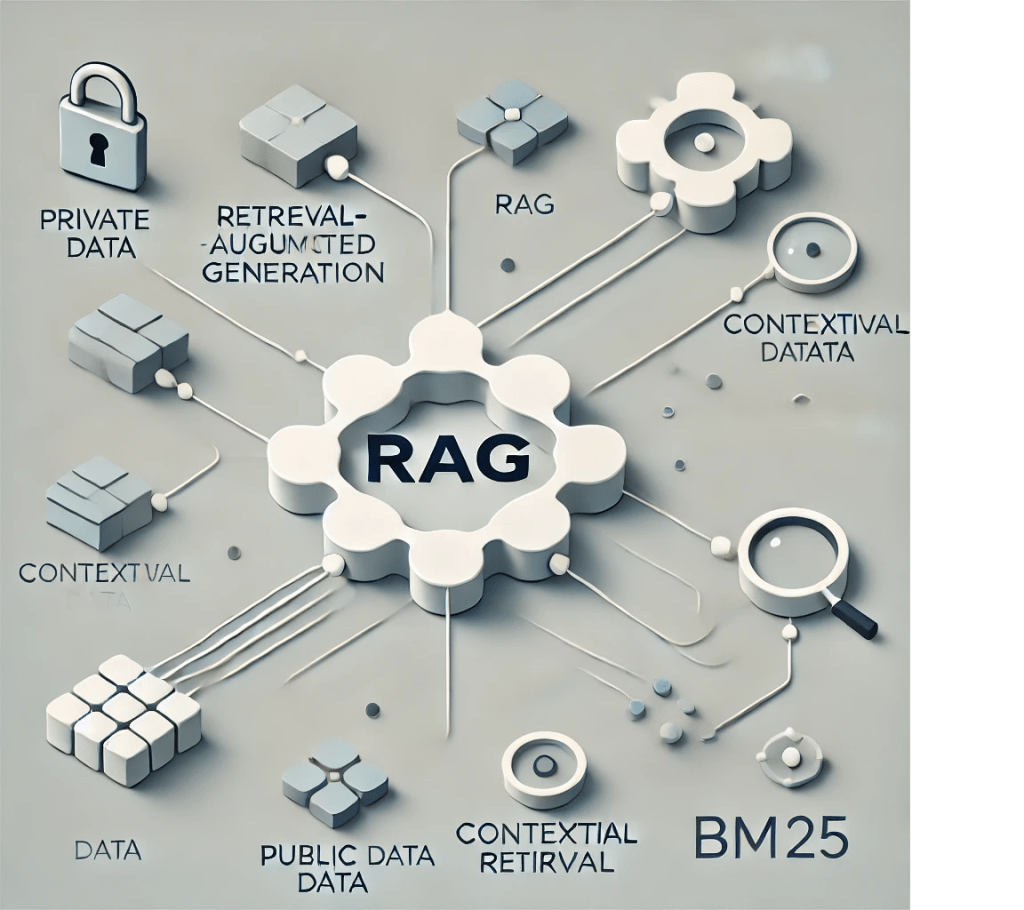
Premise: The Importance of RAG in AI and the Use of Private Data
Artificial Intelligence, particularly large language models (LLMs), has made significant advances in natural language processing and generating relevant responses.
However, to achieve their full potential, these models need access to specific and contextually relevant data.
This is where Retrieval-Augmented Generation (RAG) comes into play—a fundamental technique that enables AI models to enhance response quality by retrieving information from external sources, such as corporate databases or private documents.
One of the key aspects of RAG is its ability to integrate private data into the response generation process, thereby improving the relevance and accuracy of the results compared to models that rely solely on public or pre-trained data.
This approach is especially useful in corporate environments, where sensitive and specific information is crucial to provide precise, personalized, and contextual responses.
Additionally, RAG not only enhances response quality but also facilitates the formulation of more effective queries.
Since LLMs perform better when queries are precise and specific, RAG helps connect the user with relevant data that enhances the model’s ability to respond in a detailed and accurate manner.
The Challenge of Traditional RAG
Traditional RAG uses semantic embeddings and ranking algorithms such as BM25 to retrieve relevant information.
However, when complex documents are fragmented, the context is often lost, leading to incomplete or inaccurate responses. For example, a fragment stating, “Revenue increased by 3%” might be of little use if there is no indication of which company or time period is being referred to.
Anthropic’s Innovation: Contextual Retrieval
Contextual Retrieval, introduced by Anthropic, solves this problem by adding specific context to each fragment before it is indexed or embedded.
This context is generated using language models such as Claude and preserves critical information that would otherwise be lost.
For instance, a simple fragment like “Revenue increased by 3%” becomes “Revenue of ACME Corp in Q2 2023 increased by 3% compared to the previous quarter,” significantly enhancing retrieval precision.
The Key Role of BM25 in Contextual Retrieval
BM25 is a probability-based ranking algorithm commonly used by search engines to determine the relevance of a document in relation to a query. It works by assigning scores to documents based on term frequency and importance, improving information retrieval.
In the Contextual Retrieval setting, Anthropic has implemented a modified version of BM25 that works in combination with contextual embeddings.
This synergy between BM25 and contextual embeddings improves both lexical and semantic matching, reducing retrieval failures by up to 49%.
A Complementary Approach
Contextual Retrieval does not replace RAG; rather, it enhances it, addressing one of its major weaknesses: loss of context.
By combining contextual embeddings with BM25, the system maintains contextual coherence during information retrieval, improving the relevance of generated responses.
By adding additional reranking phases, the error rate can be further reduced, resulting in an overall 67% improvement in retrieval performance.
Applications and Impact
This innovation has vast potential for application across multiple sectors, from customer support to legal analysis, scientific research, and corporate knowledge management.
Contextual Retrieval enables AI systems to manage complex data with unprecedented precision, opening new possibilities for more intelligent and context-aware interaction with large datasets.
Conclusion
Contextual Retrieval represents an important evolution in information retrieval techniques, enhancing RAG through advanced context management.
This innovation, based on the combination of BM25 and contextual embeddings, promises to transform how AI interacts with vast knowledge corpora, significantly improving the accuracy and relevance of responses.
Reference:
https://www.anthropic.com/news/contextual-retrieval?_bhlid=cacbd9d9996eb0d15e92a66df9a92577dccfc477

 TOPFramework.Org
Lascia un commento