In today’s constantly evolving technological landscape, businesses must face the inevitability of digital transformation. However, the way organizations handle these changes can determine their success or failure.
Based on an adaptation of Kolb’s behavioral model, which originally identifies different learning styles, we can draw a parallel to corporate responses to digital transformation.
Kolb’s model is built on a cycle of experiential learning, which includes four stages: concrete experience, reflective observation, abstract conceptualization, and active experimentation.
When applied to a business context, this cycle reflects how companies absorb new information, interpret it, and take action accordingly.
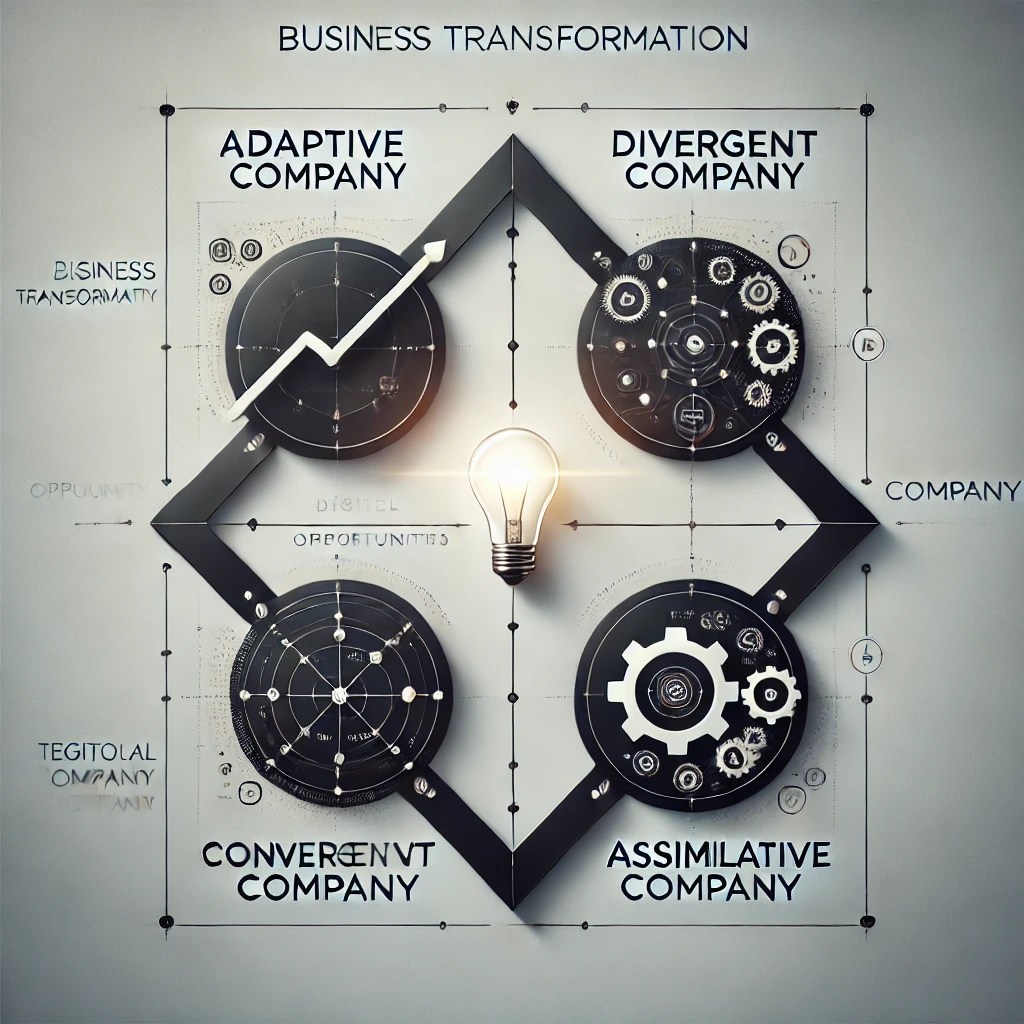
In this adaptation, we present four distinct organizational responses to digital transformation: assimilative, adaptive, divergent, and convergent.
Each of these categories reflects a different way of approaching change, with its own strategic focus, specific advantages, and potential risks.
This approach helps companies align their competencies and resources to successfully face the challenges of the digital world, choosing the strategy best suited to their context and goals.
As senior consultants specializing in digital transformation across various industries, we have seen how adopting the right strategic approach can catalyze growth, optimize operations, and prepare companies for the future.
In this article, we will explore these approaches, offering guidance on how senior managers and executives can lead their organizations not only to survive but to thrive in the digital era.
- The Assimilative Company: Building a Foundation of Understanding
Focus: Understanding Technology Before Acting
Companies in this category prioritize understanding over immediate action. These organizations are highly analytical, placing great value on deeply comprehending new technologies before making significant changes. They gather data, analyze trends, and aim to integrate knowledge across departments before executing a digital strategy.
Strategic Value: Assimilative companies avoid hasty decisions that could lead to costly mistakes. They are cautious, data-driven, and methodical, characteristics that are particularly valuable in industries where rapidly adopting poorly understood technologies could be disastrous.
Risks: However, caution can become a double-edged sword. While thorough analysis is essential, the slow pace of execution can cause missed opportunities. These companies risk falling behind more agile competitors who quickly embrace disruptive technologies.
Key Recommendation: Senior management must encourage a balanced approach—using data-driven insights for decision-making while fostering a culture of calculated risk-taking. Innovation doesn’t wait for perfect understanding, and leaders must recognize when it’s time to act with incomplete information.
- The Adaptive Company: Seizing Opportunities in Disruption
Focus: Capturing Market Opportunities
Adaptive companies excel at identifying and seizing opportunities generated by disruptive technologies. These businesses see digital transformation as an opportunity to redefine their position in the market. They are agile, visionary, and constantly looking for ways to leverage digital innovations to increase profitability and market share.
Strategic Value: Adaptive companies thrive in dynamic environments. They possess an entrepreneurial spirit and are willing to change quickly to capture emerging opportunities. This responsiveness is a major competitive advantage in industries where technological disruption is the norm.
Risks: However, agility can lead to a scattered approach. Without a well-defined long-term vision, adaptive companies might overextend themselves, chasing too many opportunities at once. This could create internal misalignment and operational inefficiencies.
Key Recommendation: Senior executives must ensure that adaptability is accompanied by clear strategic focus. It is crucial to set defined priorities and allocate resources consistently. Leaders must find a balance between exploiting disruption and maintaining organizational cohesion.
- The Divergent Company: Building Internal Strength
Focus: Developing Internal Capabilities
Divergent companies focus on the internal impact of digital transformation. Their main concern is improving internal structures, processes, and competencies that will allow them to compete effectively in a digital world. These organizations heavily invest in employee development, internal systems upgrades, and redefining corporate values to align with new digital realities.
Strategic Value: This internal focus often produces a more robust and flexible organization. Divergent companies are well-positioned to innovate from within, strengthening internal processes and personnel to meet future challenges.
Risks: The risk for divergent companies is becoming too inwardly focused. While internal capacity-building is essential, excessive emphasis on internal metrics and processes can cause them to lose sight of external market forces. Without a clear understanding of market dynamics, even the best internal processes won’t guarantee success.
Key Recommendation: Leaders of divergent companies must ensure that internal improvements are aligned with external market needs. Senior managers should promote an outward-looking mindset, ensuring that the company’s internal evolution is synchronized with external changes in the industry.
- The Convergent Company: Action-Oriented and Results-Driven
Focus: Execution and Practical Implementation
Convergent companies prioritize doing over analysis. These organizations are action-oriented, focusing on quick wins and practical solutions that deliver immediate, concrete results. Their goal is to optimize processes and rapidly deploy digital tools to meet user and customer needs.
Strategic Value: Speed of execution is the hallmark of convergent companies. Their ability to quickly turn strategies into actions allows them to capitalize on early wins, increasing competitiveness in fast-moving markets. The 80/20 principle—focusing on the 20% of efforts that generate 80% of the value—is a core operational tactic.
Risks: However, this rush to execution can sometimes lead to short-term thinking. Convergent companies might overlook the importance of long-term planning and risk being reactive rather than proactive. Additionally, the focus on speed can lead to a neglect of innovation, causing growth to plateau.
Key Recommendation: Senior management must promote a balance between execution and long-term strategy. While action is essential, short-term efforts must be aligned with long-term goals. Moreover, fostering innovation alongside operational efficiency is critical for sustained growth.
Conclusion: Choosing the Right Approach for Your Organization
Digital transformation is not a one-size-fits-all journey. The right approach depends on each organization’s context, industry, and goals. As senior consultants with experience across a wide range of industries, we have seen how these four strategic archetypes—assimilative, adaptive, divergent, and convergent—play out in real-world scenarios.
For senior managers and executives, the key is assessing where your organization currently stands and what is needed to ensure its success. Whether the goal is deepening understanding, seizing new opportunities, strengthening internal capabilities, or focusing on execution, the path forward is always a matter of strategic balance.
Digital transformation is not just about technology—it’s about organizational evolution. More importantly, it’s about leadership that can guide companies to build the skills, structures, and visions necessary to navigate disruption and thrive in the digital age. Successful companies are those that understand their strengths, recognize their weaknesses, and possess the strategic capacity to adapt accordingly.

 TOPFramework.Org
Lascia un commento