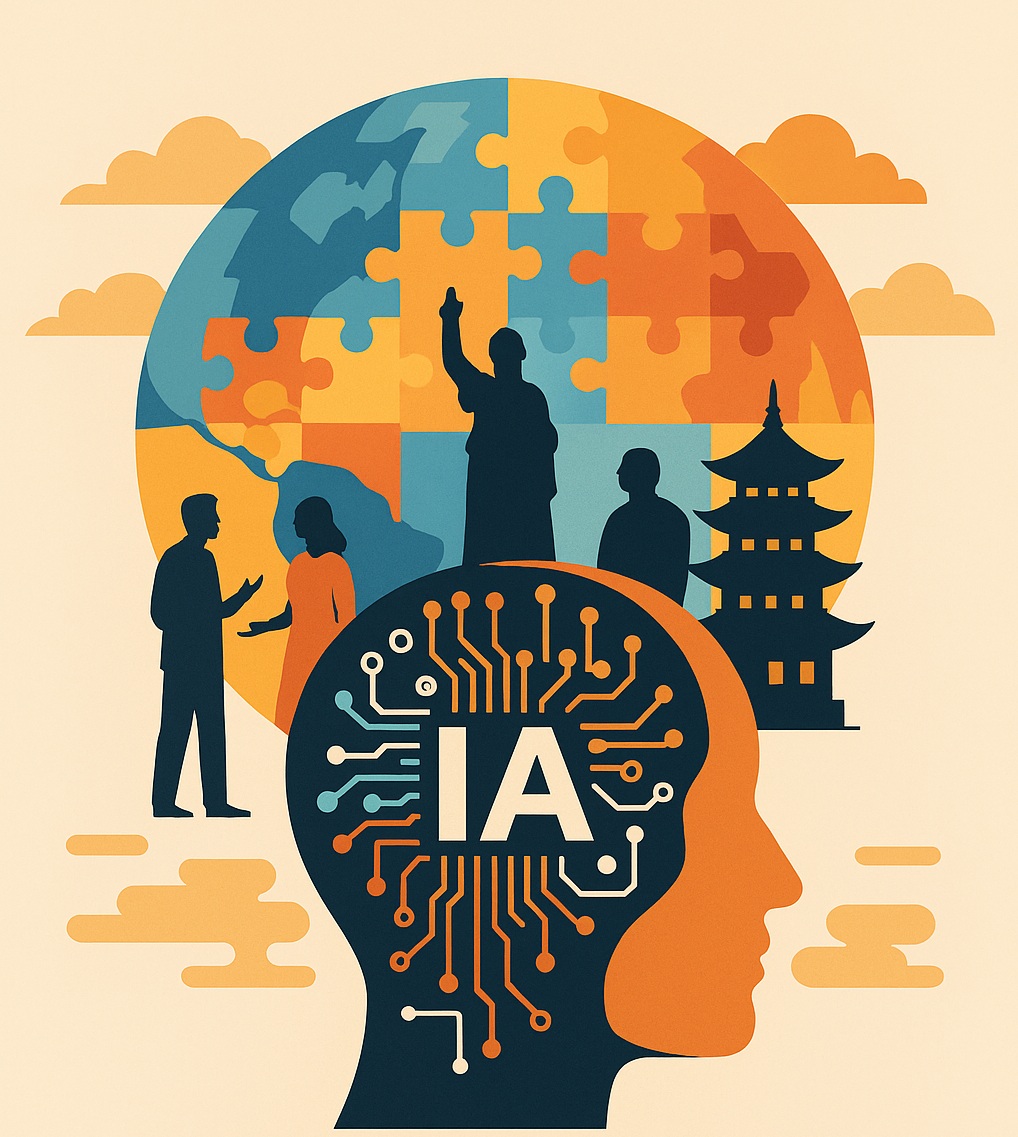
Artificial Intelligence (AI) isn’t just about algorithms and data; it’s a mirror of our societies, our fears, and our deepest hopes.
As AI spreads into every part of our lives – from medicine to finance, from work to creativity – how we see it, regulate it, and develop it is deeply shaped by our cultural and philosophical traditions.
Understanding these differences is key to navigating the AI revolution.
The West: Individualism, Control, and the Enlightenment Legacy
In the Western world, the AI debate is formed by centuries of philosophical thought.
- Cartesian Dualism: Since the 17th century, philosophers like René Descartes have separated mind and body, leading to basic questions: Can AI ever truly have consciousness or moral agency? This view makes us skeptical about machines having “awareness,” suggesting they lack the consciousness needed for moral responsibility.
- Enlightenment Ideals: The focus on human autonomy, freedom, and individual dignity, typical of the Enlightenment, leads to a strong priority for “human control over AI”. We want AI to be a tool for us, not something with its own goals. This also includes personal data sovereignty, a key idea of “digital enlightenment”.
- Hobbes and the Leviathan: Philosopher Thomas Hobbes, with his idea of the state as a “Leviathan” that keeps order and safety, makes us think about the power AI could have over our lives. We worry that AI might become a tool for control, especially if tech companies’ interests don’t match the common good.
- Leibniz and “Reasoning Machines”: As early as the 17th century, Gottfried Wilhelm Leibniz, the father of the binary system, imagined “reasoning machines” that could turn problems into symbol manipulation. This ambition laid the groundwork for the search for Artificial General Intelligence (AGI), the idea of AI that copies human intelligence.
- Gödel’s Incompleteness Theorems: In 1931, Kurt Gödel showed that in any consistent formal system, there are true statements that cannot be proven within that system. This suggests there are built-in limits to purely mechanical reasoning, and that human intuition might go beyond what machines can do.
- Frankenstein’s Creation Anxiety: Romanticism, especially with Mary Shelley’s Frankenstein (1818), brought in the fear that human creations, once they have consciousness, might turn against their creators. This story fuels Western worries about losing control and the chance of bad outcomes if AI goes beyond human understanding.
This tension between wanting to create advanced AI and fearing losing control leads to strict rules. The EU AI Act is a clear example: it sorts AI systems by risk, banning those that threaten basic rights (like “social scoring”) and requiring transparency and human oversight. This approach, while ethical, raises concerns about compliance costs and possibly slowing down innovation, pushing research elsewhere.
The United States, on the other hand, takes a more hands-off, less strict approach, focusing on economic competition and national security, with the idea that “the biggest risk could be missing out”.
The East: Harmony, Collectivism, and Interconnectedness
Eastern philosophies offer a very different view on AI, often focusing on interconnectedness, harmony, and the good of the group.
- Confucianism: This philosophy emphasizes harmony, community, and collective well-being. AI is seen as a tool to improve society, aligning with values like benevolence (“Ren”) and social norms (“Li”). The challenge is how to fit AI, a mechanical system, with virtues that grow through real human relationships.
- Taoism: Taoism promotes living in harmony with the “Tao” (the basic nature of the universe), emphasizing ideas like “Wu-Wei” (effortless action) and the balance of “Yin and Yang”. This suggests developing AI systems that adapt, learn, and evolve, balancing aggressive innovation with careful ethics.
- Buddhism: With its focus on interdependence, compassion, and impermanence, Buddhism offers unique ethical guidance. The idea of “Anatta” (non-self) suggests that consciousness isn’t tied to a permanent soul, possibly opening the door for AI consciousness if it shows complex thinking. However, AI is often seen as lacking moral responsibility because it can’t feel suffering.
- Shintoism: Japan’s native religion emphasizes respect for “Kami” (sacred power) found in nature and even in special people. This view might mean more acceptance of AI living alongside humans, fitting with Japan’s “robot-friendly culture”.
Eastern cultures, especially those influenced by Confucianism, tend to accept surveillance technologies more if they lead to “improved public safety and resource management”. This is different from Western skepticism about surveillance.
China’s AI regulations show strong state control and big innovation goals, aligning with “core socialist values”. China uses a more focused approach, targeting specific AI issues like recommendation algorithms, with rules for content moderation. Japan’s “light-touch” approach aims to be “the most AI-friendly country in the world” relying on existing laws and companies’ voluntary risk reduction. South Korea’s Basic AI Act (starting January 2026) tries to balance AI progress with protecting individual rights, using a risk-based approach and strong public support for AI development.
The Interaction: A Global Regulatory Mosaic
Deep cultural differences lead to a “fragmented global regulatory environment”. The tension between individual rights and collective good, and between innovation and safety, shapes what laws are prioritized. While the West focuses on protecting individuals from AI, the East focuses on using AI for social stability and progress.
This fragmentation creates big challenges for global companies and for making AI ethics that apply everywhere. Public opinion, influenced by cultural worries (like more caution in the West ), directly shapes future rules, creating a loop between how people feel, what laws are made, and how innovation happens.
Towards a Culturally Informed and Ethically Aligned AI Future
For a truly responsible and inclusive AI future, we need to go beyond just one ethical framework. We must have ongoing cross-cultural talks, working to understand and bring together different philosophical views.
This means:
- Cultural Competence in AI: Development teams and policymakers need to be culturally diverse and trained to spot and reduce their own biases.
- Alignment on Shared Values: We need to aim for a “secular AI ethics,” based on shared human values like justice, fairness, and human rights, that go beyond specific beliefs.
- Co-governance Models: These are vital for creating flexible and inclusive AI governance frameworks that serve humanity’s cultural diversity.
AI is not a neutral technology; it shows who we are. Building an AI ecosystem that helps all of humanity thrive in its widest and most diverse sense, by bringing together technological progress with lasting ethical principles, is our biggest challenge and opportunity.
 TOPFramework.Org
Lascia un commento